The story behind the build
By Scott Kruize
Monogram Wright Brothers Kitty Hawk
Kit #5300, first issued in 1958
Regular readers will recognize my made-up word “NABBROKE.” It is an acronym for “Nostalgic Aging Baby Boomer Real Old Kit Experience.” The concept acknowledges modern kits are infinitely better—in every way—than the ancient ones we all used to build Way Back Then, because that is all that was available. But in the process, some of the joy we took in modeling Way Back Then has been lost in the Now, which is why I claim to fellow modelers that doing a NABBROKE occasionally can be a relaxing and fun break. And, of course, it promotes recognition of how good we have it Nowadays, while reminding us how impatient we were way back Then. My eyes were sharper, my hands steadier—but I was missing knowledge and experience, and certain mental qualities I have since acquired.
Our access to reference resources is next-to-unlimited, especially with the Internet. But the information is not just Out There; it has to be found and absorbed. Mentally, it is a “given” to follow instructions from manufacturers and from other modelers, that none of us knows everything, and how foolish it is to ignore mistakes others made, overcame, and took the time and trouble to write up for the benefit of their fellow modelers.
Mainly, I have patience. Back Then, builds were rushed through in as little time as possible. It seemed like an eternity would need to pass if drying paint and glue meant waiting overnight and through a whole endless school day before being able to finish up.
Around 2000, I emerged from the Dark Ages and began to build plastic display models again: an assortment of modern kits mixed in with NABBROKEs. A big discovery: virtually every model I remember from way back Then can still be gotten today. “Old molds never die; they just get re-popped”—often improved, with better instructions, documentation of authentic color schemes, and fine modern decals to make those easily achieved.
Early on in modern times, I began to come upon reissues of Monogram kit number 5300, originally released in 1958. But I have to admit it is not a NABBROKE for me. I never built one—but I had one!
Between ages six through nine, it was a different culture where everyone knew young boys built models. Friends and relations sometimes gifted me with one, on a birthday or Christmas. Particularly my paternal grandparents, who never seemed to have a clear idea what I really liked. Their gifts had to be received with the most sincere gratitude, even while inside I may have been saying “WTF?” (Well, its childhood equivalent.) I can still name a book they had somehow decided I must read: Prince Dimitri’s Mountaineers. I cracked it, bogged down in it instantly, set it aside, and have no more idea what it was all about than where it finally disappeared to. Any fans of this book: I would love to hear your take on it.
So they, or someone, gave me the Kitty Hawk kit sometime between the issue date when I was seven and my tenth birthday party, when I got Monogram’s B-58 Hustler and its “Exciting Weapons Pod Release!”
Earlier gift kits were put together by my father, with me watching and pretending to help. Father would glue the basic parts together. It did not occur to either one of us that a bunch of small details and fittings, much less the whole model, ought to be painted. The only finishing the kit would get was its waterslide decals. That is where I made my greatest contribution!
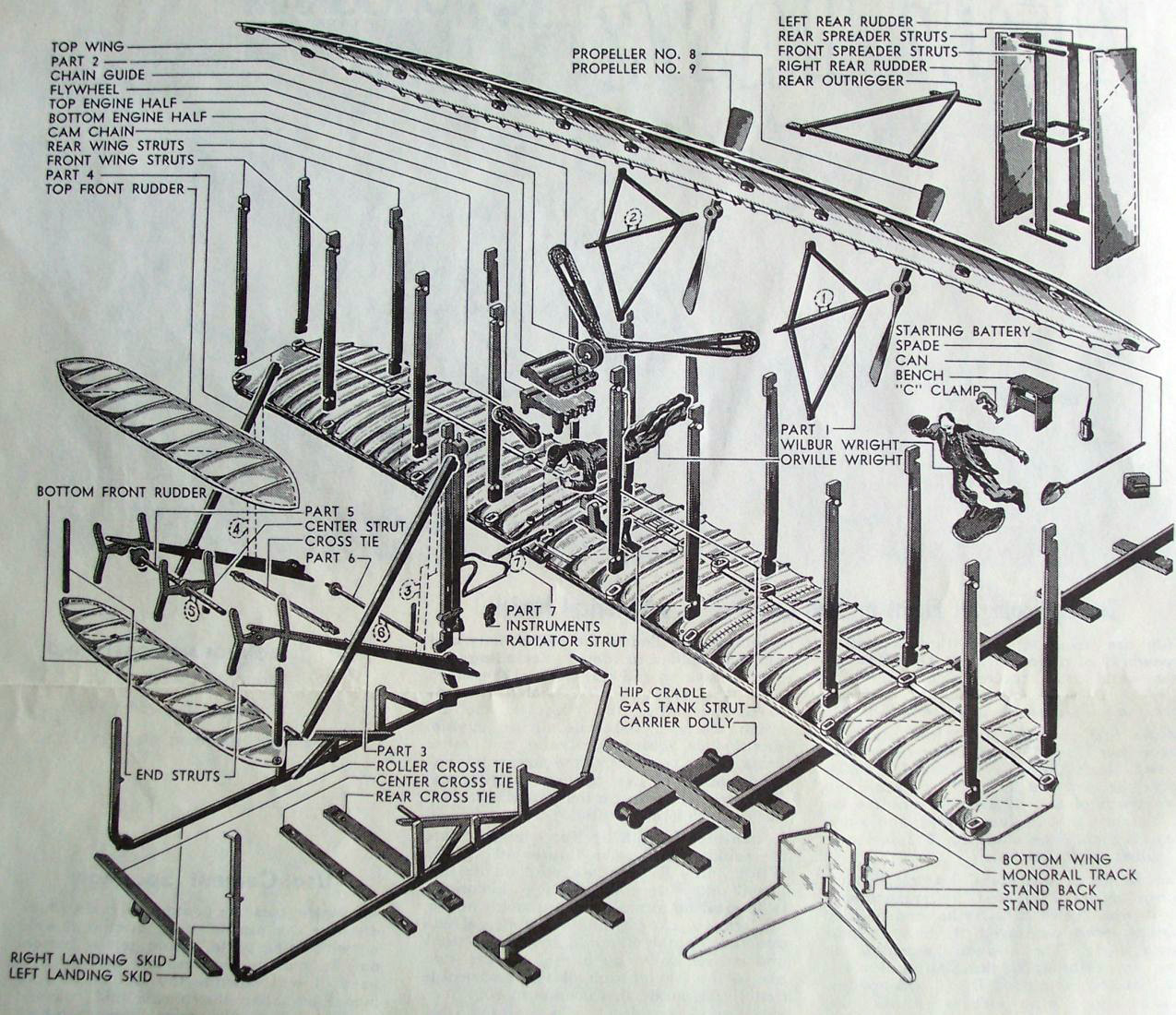
When the two of us opened this kit box one evening, I remember admiring clever parts like two little figurines, a step-stool, shovel, oil can, and the take-off track and trolley. It seems to me we spent maybe two evenings futzing with it before Father made some sincere excuse that got him off the hook for finishing it. I was not overly disappointed; we went on to the next thing, and I took several parts to play with and consume in sandbox construction-vehicle projects. But when a somewhat beat-up box was encountered at Emil’s Skyway Hobbies, pen-marked “Started” over a price tag of five dollars, I knew I had to buy it and try this build for myself.
I surmise that somebody got this kit and thought because of its release a long time ago, it would make for a basic, quick build—then realized that it was going to take a lot of effort and gave up. My turn!
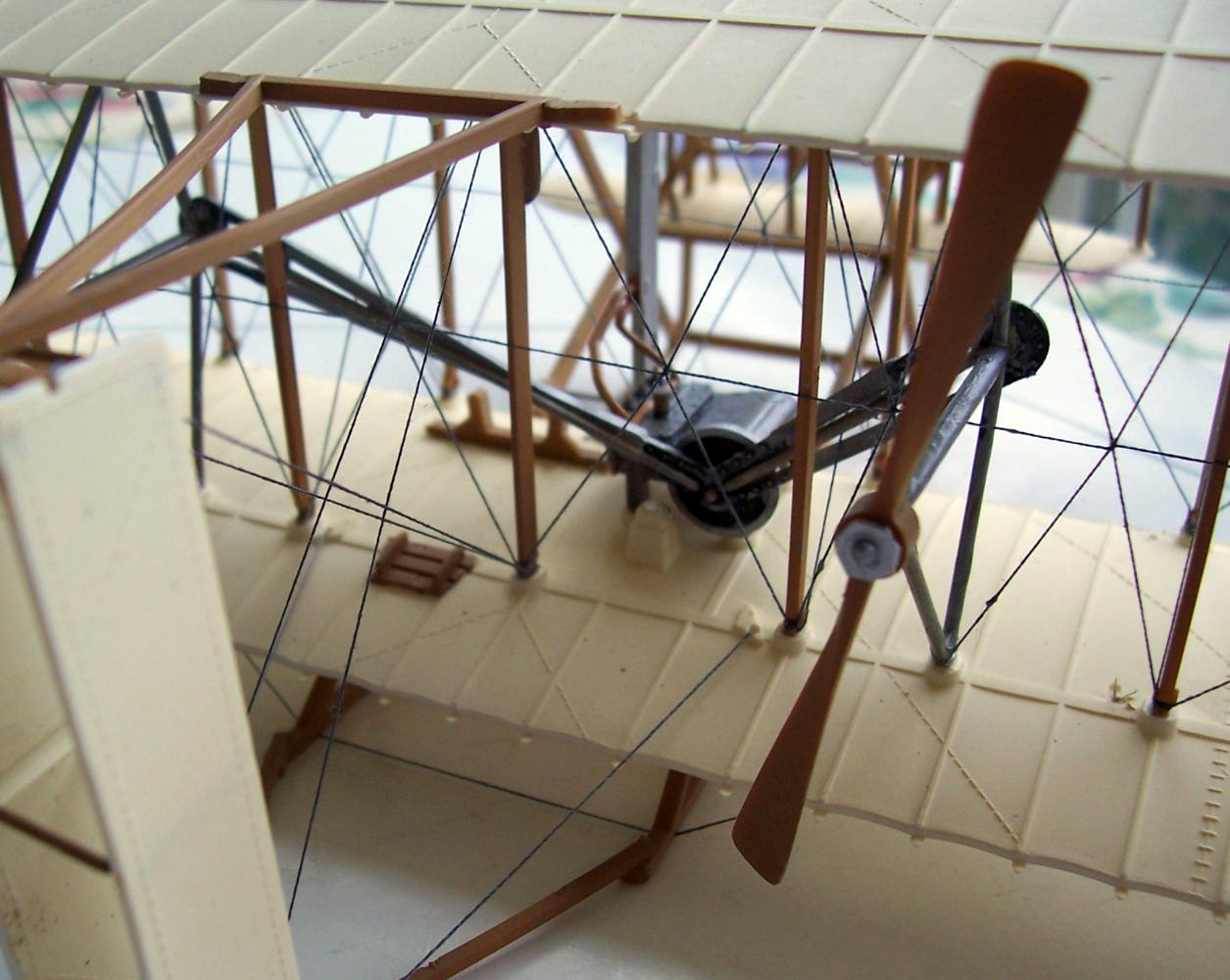
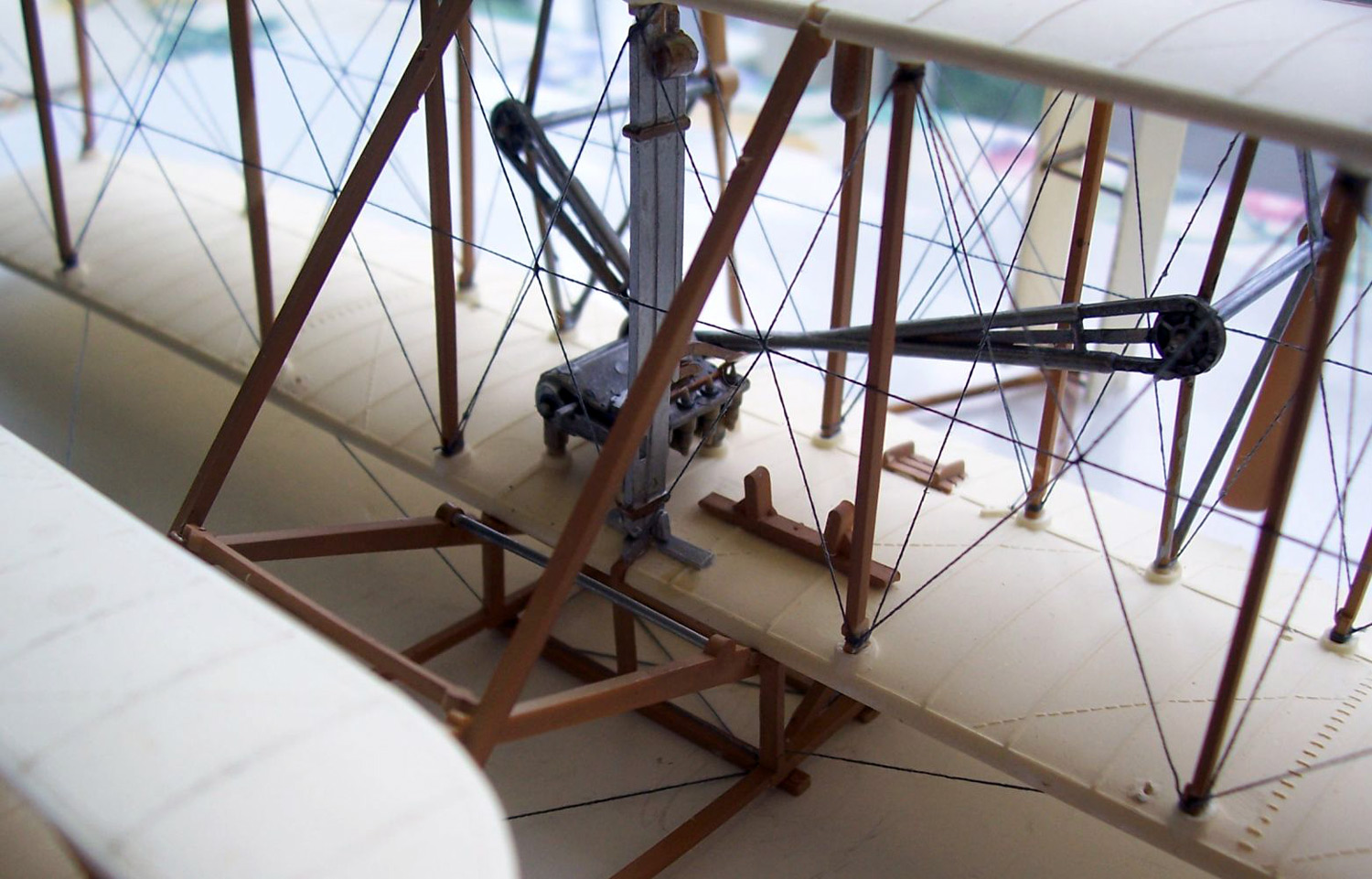
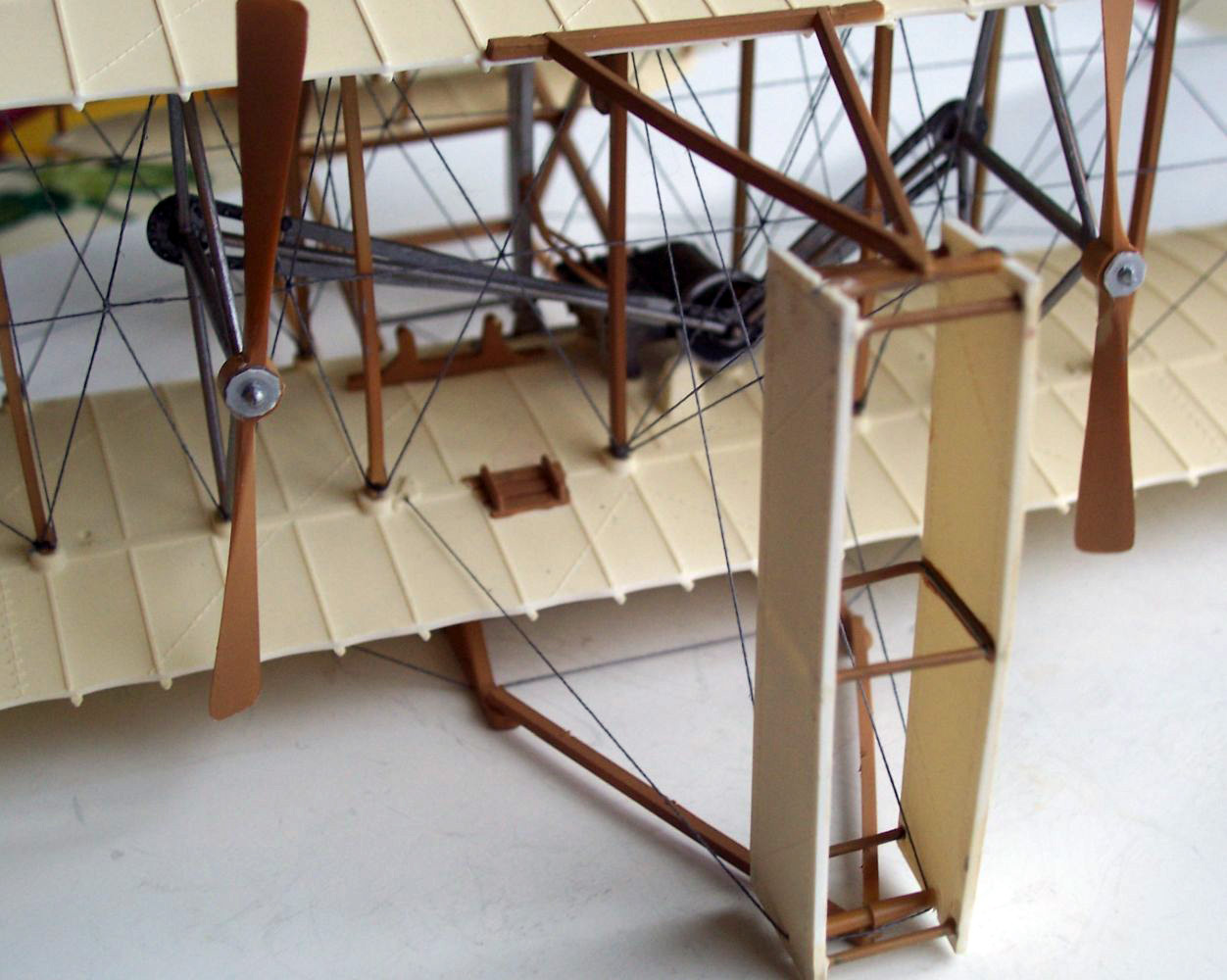
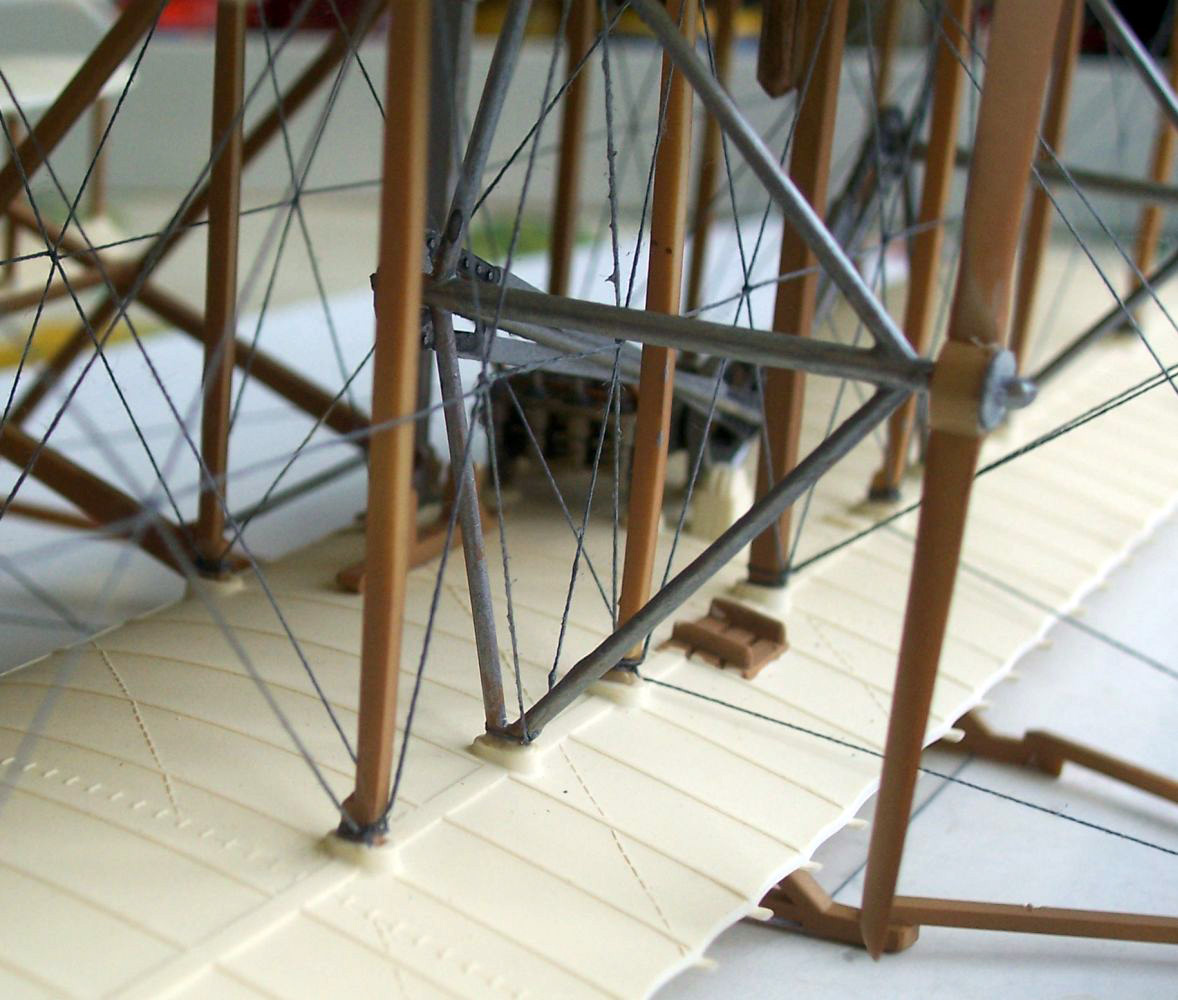
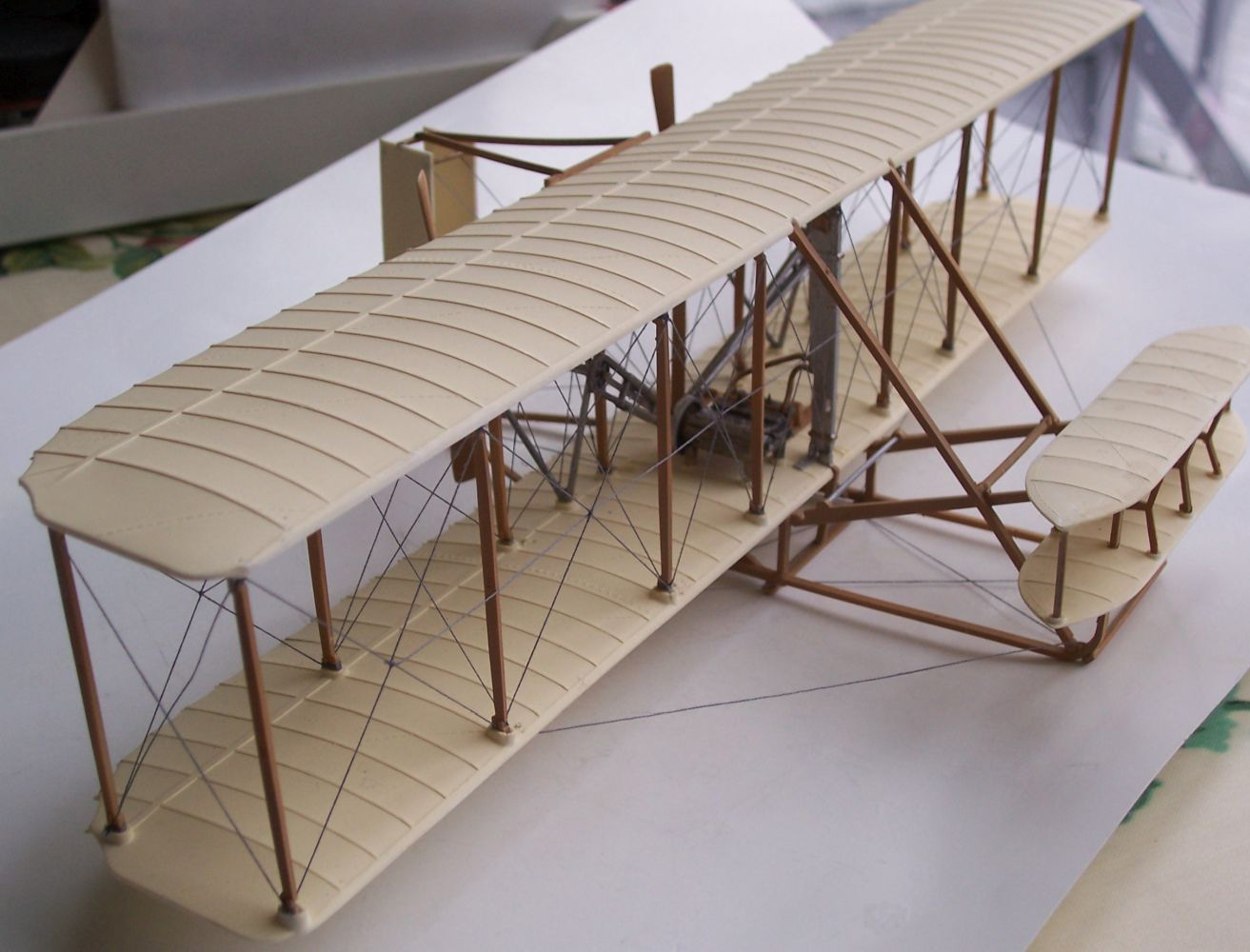
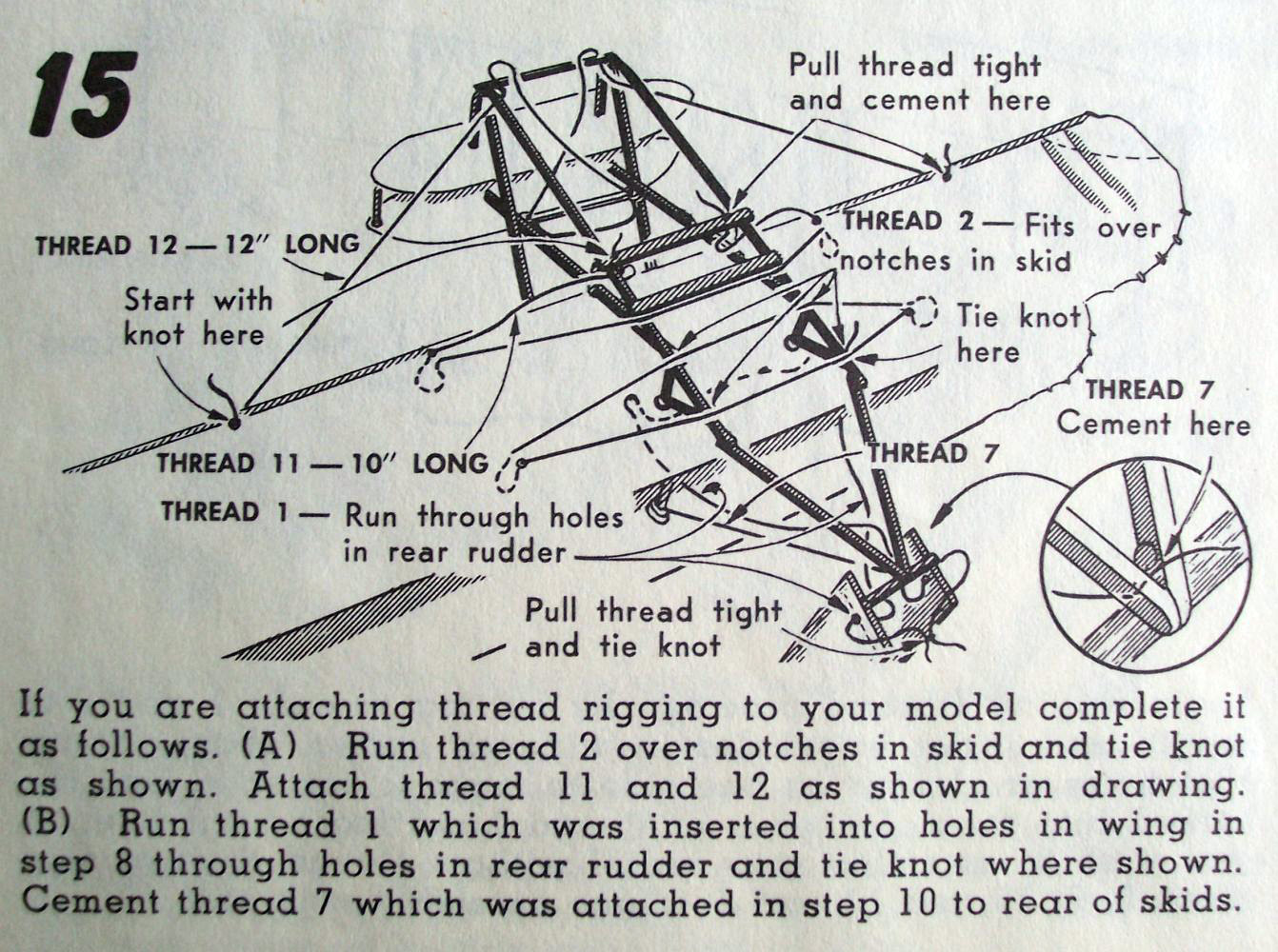
From a current perspective, especially knowing what the best companies are doing now with CAD/CAM-based precision molding, I have to say this kit is well-engineered for its purpose. The subject is complex and “fussy,” but the Monogram engineers did a pretty good job trying to put it all within reach of modelers nowhere near the skill levels of current readers. For example, the dozen or so struts have neat little slots molded in to accept rigging thread, and they fit snugly upright into sockets in the wings and other flying surfaces. Those sockets would not impress modern IPMS contest judges, but do make it possible for a non-expert to assemble the parts, and even achieve decent alignment of surfaces, with reasonable ease.
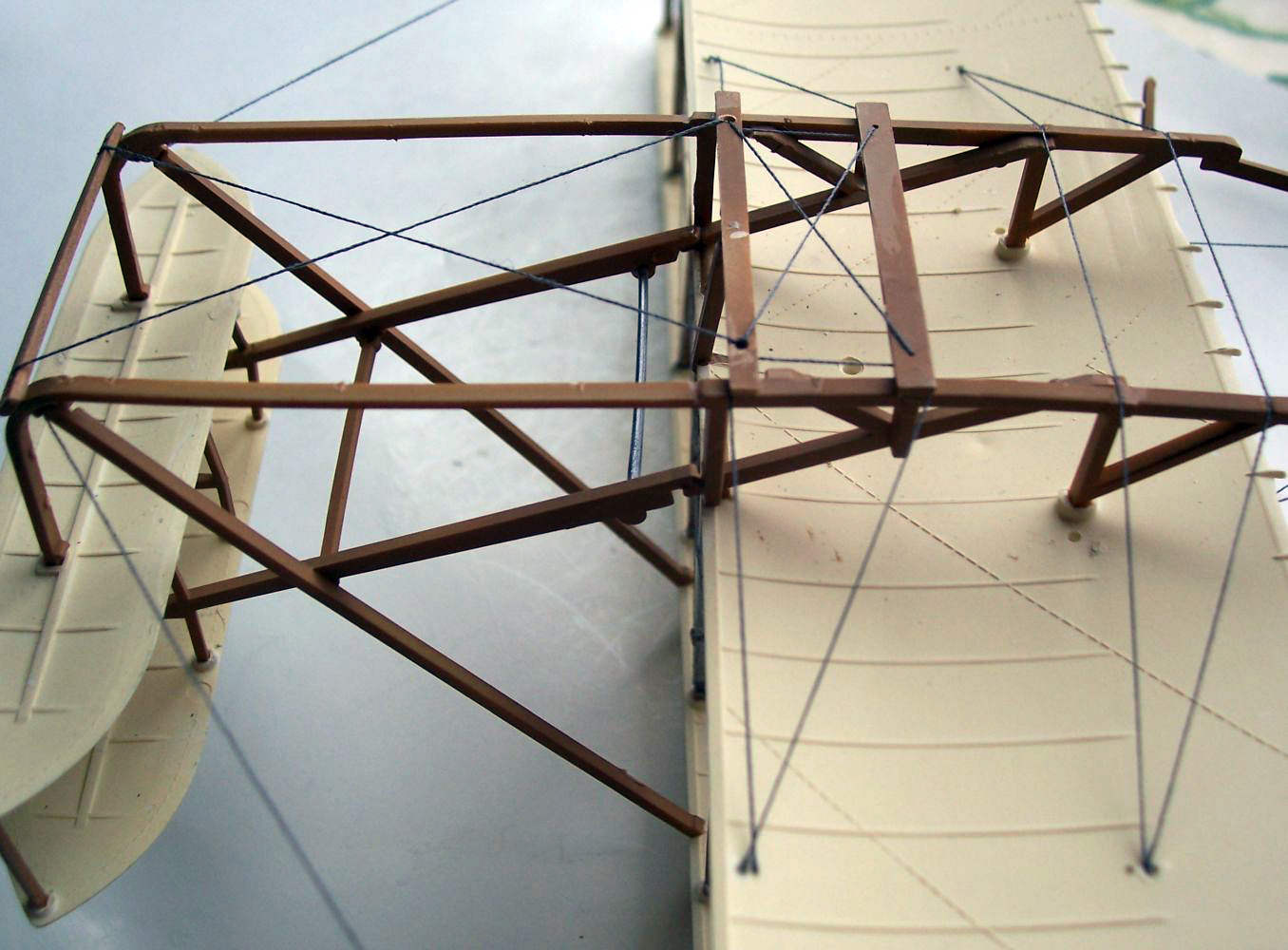
Similarly, the strutwork that holds the forward elevators and rear rudders—both biplane assemblies—has been well thought out and fairly well illustrated and described in the instructions. All this is time-consuming and, again, fussy, but while doing these assemblies it was hard to think of any way they could have been simplified further without sacrificing a great deal of accuracy.
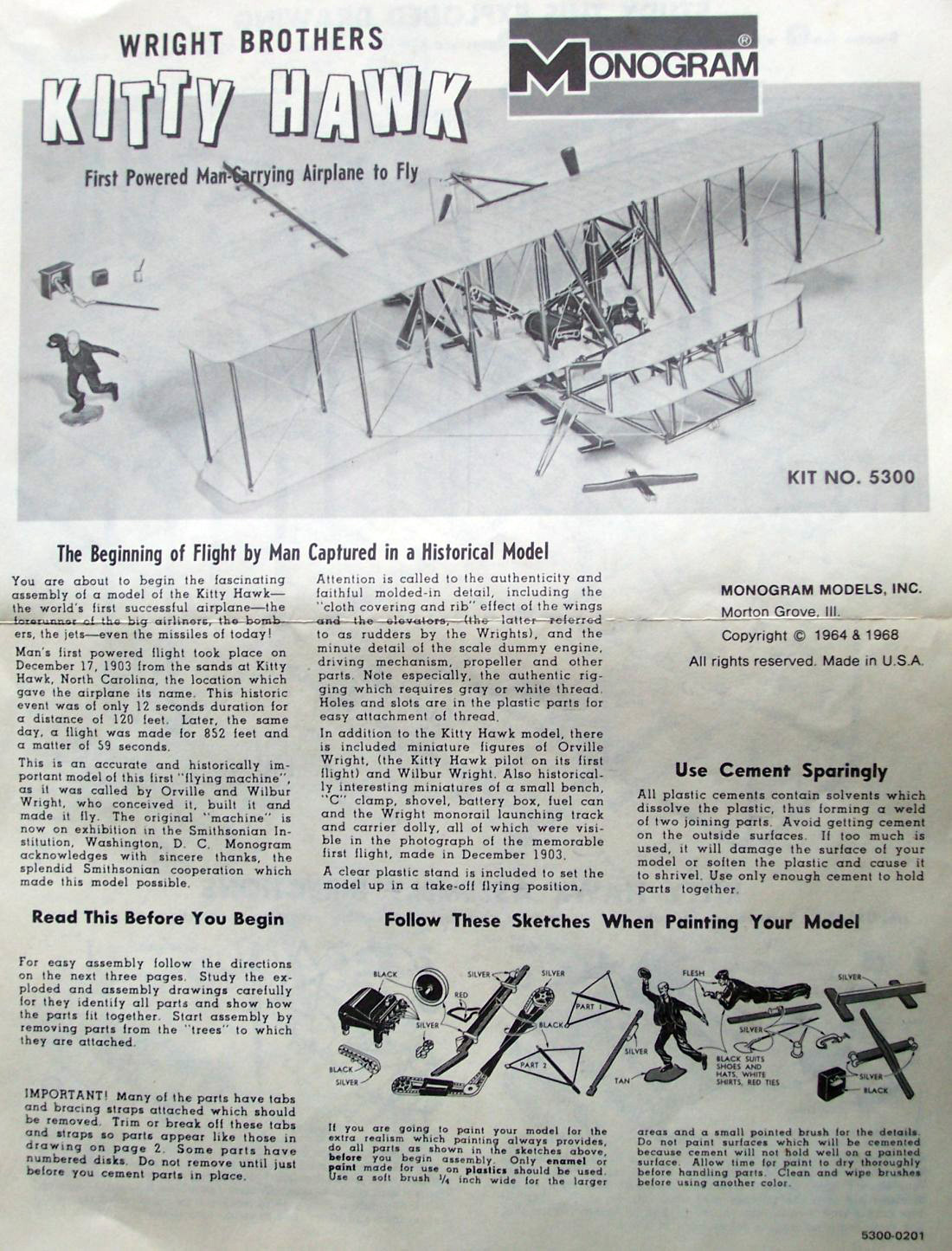
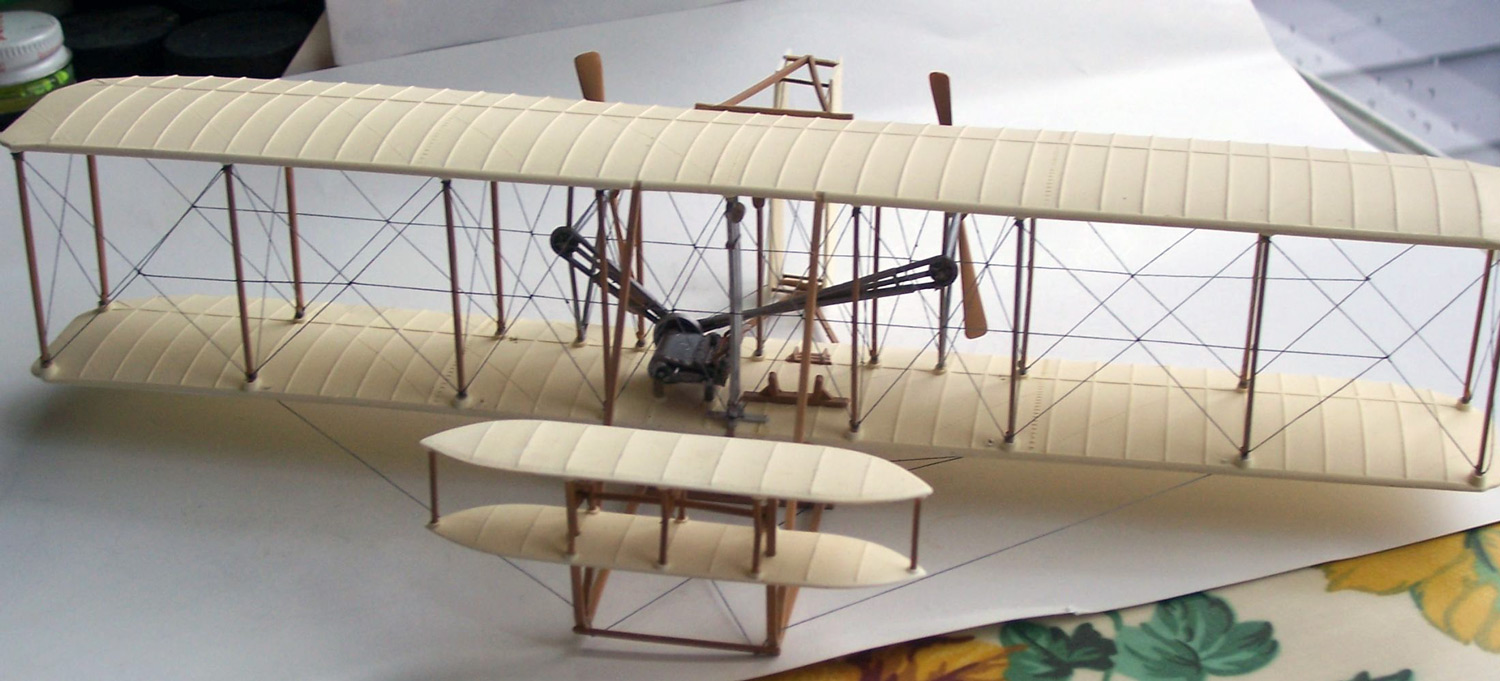
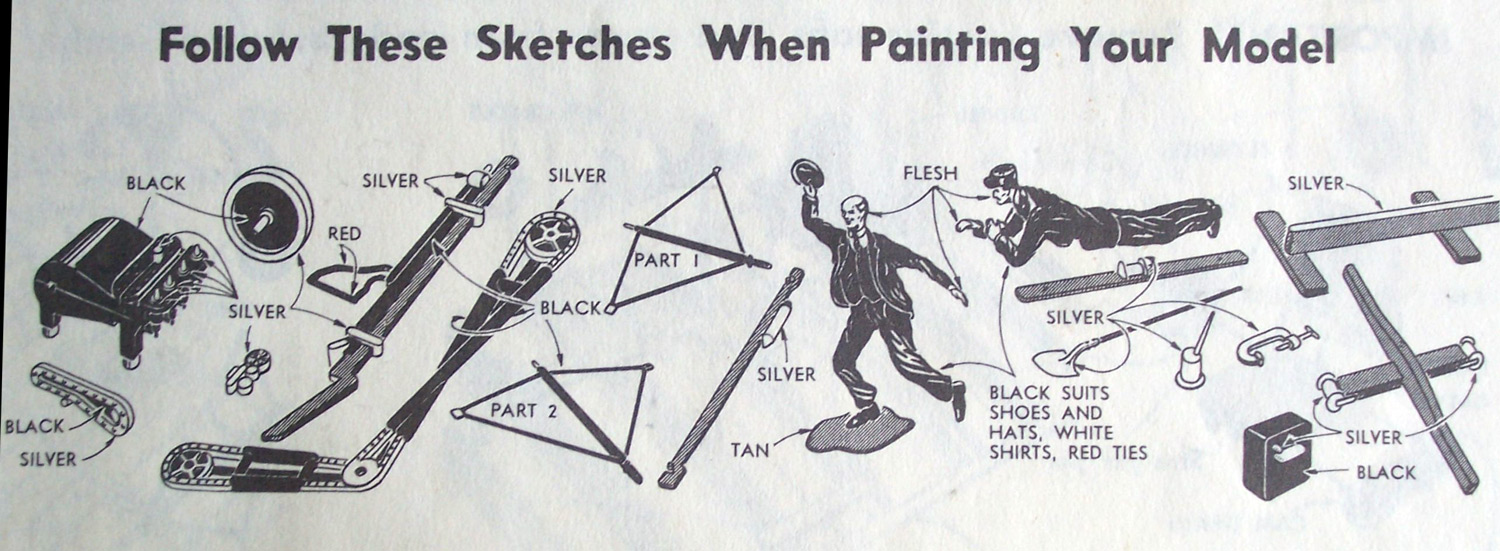
Deliberately, Monogram made this kit as authentic as possible without needing paint. The flying surfaces are molded in a neutral off-white or tan, much like clear-finished linen. The strutwork and propellers are molded in medium brown. Engine, drive chains, and figurines are black. Not to say there are not painting instructions: the first page shows details, such as indicating Wilbur and Orville actually did wear black suits, so it is only a matter of painting their faces and hands, white shirts, and red ties. Different culture in 1903, eh whot? Who can imagine wearing suits and ties in the wintertime while working outdoors on greasy experimental machinery?
I painted every part. Of course, matte-finish paint tones down the plastic parts’ shininess for a better visual effect. But all the colors essentially duplicate the plastic mold colors, and the finished product you see in my pictures probably does not differ much from one left unpainted.
The last operation was to rig. Monogram’s kit includes a spool of very fine, very smooth, almost metallic-gray polyester thread. Thinking not much improvement would result from some other material, I used theirs. The rigging job took perhaps four or five hours over three work sessions. I did follow instructions, including using those pre-molded slots to go from strut to strut to strut in long runs. My rigging experience is more-or-less extensive, certainly compared to the past. Still, it was not easy. No way would Father have had any hope of doing it!
I got a great deal of satisfaction from seeing the Kitty Hawk finished. It is like reaching back over half a century to resume what I took only a feeble step toward, way back Then. Besides, since going to model-club meetings with Show-and-Tells, Museum of Flight displays, and contests and shows with IPMS Seattle and NorthWest Scale Modelers, I have never seen anyone bring a build of this kit. Everyone has known about it, but never put out a completed one on display, in my time or anywhere I have been. That is particularly gratifying and reinforces my assertion that taking a break from modern kits—however good—and doing a NABBROKE is fun and can qualify as a current challenge!